Will Pebble smartwatch be able to compete with Apple and Google?
140106c.steel-trio-1024x640

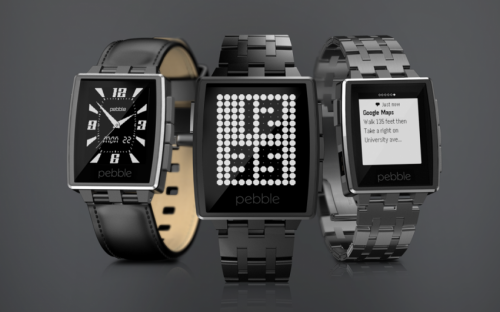
Time’s a ticking for Pebble. As the Palo Alto, Calif., smartwatch maker recently started sending the latest model of its phone-connected watches to those who helped fund its development, analysts cast doubt over its ability to compete with the likes of Apple Inc. and Google Inc.

“They’re in a very difficult position right now,” said technologist Stephen Fluin, an expert on mobile phones and wearable devices. “They were the first smartwatch of any kind of scale, they sold more than a million of the original, and they have a lot of favor in the community. Flash forward to now after a year of Android Wear and the recent launch of Apple Watch, and the realities of their project have become more apparent.”
According to analysts, Pebble faces two challenges: a lack of resources compared with its competition and an ongoing struggle to define its audience.
With the former, Pebble was initially funded through crowdfunding platform Kickstarter, where it raised $10.3 million in 2012, making it one of the most successful fundraising campaigns of its kind. But compared with Apple and Google – two tech behemoths with billions of dollars at their disposal – Pebble faces an uphill battle in recruiting the talent, developing the technology and investing in the marketing required to compete at the same level.
Analysts have said smaller smartwatch makers don’t necessarily have to compete head to head with the likes of Apple and Google to be successful and profitable. But to remain relevant, they do need to clearly differentiate themselves – and analysts aren’t convinced Pebble has done that.
Apple and Google have positioned their watches as luxury fashion items as opposed to geeky gadgets, pursuing a more mainstream audience. Pebble has been less clear about who its watch is for.
The Pebble isn’t as refined as Apple or Google’s offerings, said Dan Ward, co-founder of app development firm Detroit Labs, but it’s also not as utilitarian as Garmin’s fitness watches, which makes it a difficult sell in an increasingly crowded marketplace.
“Design is just as important as what’s under the hood,” Ward said. “When Motorola first launched its smartwatch, there was extra buzz around the Moto 360 because it’s gorgeous. Then with Apple, we saw it strategically launch in six designer boutiques around the world, which is the first time anyone has done that.”
The smartwatch race looks increasingly like a David-versus-Goliath situation, with Canalys analyst Daniel Matte saying it’s “basically impossible” to compete with Apple, Google and Samsung, which have “many orders of magnitude more resources.” But Pebble isn’t necessarily out of the race.

Pebble has distinct advantages over the main competition, Matte said.
Being created by neither Apple nor Google means Pebble’s watches are compatible with both iOS and Android, giving users the ability to switch between phones without having to change watches.
The Pebble also has a longer battery life, lasting up to seven days on a single charge compared with the Apple Watch and Android Wear, which last one to two days.
Pebble’s watches also lack the bells and whistles of its competition, which, while perceived as a weakness for some, could be one of its strengths, Matte said.
“It’s a very simple, streamlined product,” he said. “They’ve made something that’s not intrusive to your life.”
The lack of intrusiveness is what appeals to Pebble user Tim Shrimpton, 32, a San Francisco Bay Area resident who backed the original Pebble on Kickstarter.
“The thing I like about it is it’s first and foremost a watch,” Shrimpton said. “The screen is always on. You don’t have to do anything to it. Even having to flick your wrist to get it to turn on (as is it the case with the Apple Watch) seems counterintuitive.”
Some watch wearers find the feature-packed offerings from Google and Samsung off-putting, and have gravitated to Pebble’s minimalist design.
“I don’t want a million features – long battery life and being a watch first appeal to me,” said Pebble user Aaron Crocco, 35, of Selden, N.Y. “Pebble goes with ‘Less Is More,’ and I appreciate that.”
Pebble Chief Executive Eric Migicovsky said Apple’s and Google’s foray into the smartwatch market has helped the company by raising awareness of smartwatches, which has led to consumers seeking out alternatives.
“We’re not going after that luxury jewelry market like Apple is,” Migicovsky said. “The original Pebble was simple. We didn’t say it was a revolutionary device that would change your life. It did a couple of things like text messages, email, calls, the ability to control your music, and did them well, and I think it clicked with our customer base.”
The latest Pebble watch, the Pebble Time, which recently shipped to Pebble’s Kickstarter backers and will soon be available to the wider public, sticks to Pebble’s simplicity ethos by further streamlining the experience. Instead of loading the watch with dozens of individual apps, the Pebble Time lets users organize and view information chronologically in a timeline format.
Pebble also plans to soon offer “smartstraps,” wrist straps with different functions such as GPS and heart rate monitoring that users can swap onto their device.
Like many of Pebble’s other features, the smartstraps are developer friendly, and Pebble has even posted 3-D printing instructions online for building a Pebble smartstrap, encouraging developers to make their own.
Pebble’s openness to developers is another strength. The company stands in stark contrast to Apple, which is notoriously cagey about its products, going so far as to reject apps that mention their compatibility with other platforms such as Pebble.
Fluin believes Pebble can stay in the race if it can clearly carve out a niche for itself. One idea is to position itself as a geek product that appeals to the do-it-yourself crowd who like making or tinkering with gadgets, he said. Or with its lower price (Pebble’s original model starts at $99), it could appeal to children and families, Ward said.
Matte said the company could even pivot to being a software company that focuses on making apps for smartwatches.
Migicovsky has given no indication that Pebble will point itself in either of those directions, but Matte says “it’s a plausible survival strategy.”
Whatever direction it does choose, analysts agree it needs to be more bullish about it.
“With the mobile and wearable landscape shifting as rapidly as it is, you’re either growing and succeeding, or you’re fading and dying,” Fluin said. “With Pebble … I don’t think they’re out yet.”

References:http://phys.org/
With revamped app, news to be at core of Apple

appleisdivin

Apple is diving deeper into the news business with a new application that could make the US tech giant a key industry player.

Apple News, part of the upcoming iOS 9 operating system, aims to be the primary news source for users of the iPhone and iPad—likely at the expense of sources such as Facebook, Google and news apps such as Flipboard.
In a surprising move, Apple has unveiled it will be hiring experienced journalists to manage its news feeds—marking a departure from the algorithmic process used by rivals.
“Apple is eager to have news created by human beings and not algorithms—it fits in with the brand statement Apple has been making,” said Judd Slivka, a professor of mobile journalism at the University of Missouri.
“The expectation is they will put together a smart team that works well broadly across news and specific content areas.”
Although Apple has offered few specifics on its plans, the company’s jobs listing page said it is “looking for passionate, knowledgeable editors to help identify and deliver the best in breaking national, global, and local news.”
The page said the editors should have “great instincts for breaking news, but be equally able to recognize original, compelling stories unlikely to be identified by algorithms.”
This marks a distinction from rivals such as Facebook, which is crafting formulas that aim to deliver articles users want based on their Web habits, demographics and interests.

Fed by robots?

Although Apple is likely to use some algorithms to filter stories, the hiring of experienced journalists is a positive step, said Dan Kennedy, a journalism professor at Northeastern University.
“A lot of people don’t want to be fed news that a robot has decided interests them,” Kennedy told AFP.
“Especially if you don’t have any say how the robot makes that decision. The Facebook algorithm is highly mysterious, and people are starting to resent that.”
Kennedy said it is “encouraging that this is moving journalism to the center of Apple’s universe.”
But he remains cautious about technology companies increasingly becoming gatekeepers for news.
“I’m not crazy about the idea of shifting news to huge corporations like Apple and Facebook that have their own agendas,” he said.

References:http://phys.org/

Web-based services that store too much personal data

webbasedserv

Photos, videos, PDF documents and location data: the permissions requested by some apps give them access to more information than users are aware of. EPFL researchers have come up with a tool to better follow and manage these risks.

Exactly what personal data are we putting on the web in the era of the cloud? Often much more than we want or even imagine. That is what researchers at EPFL’s Distributed Information Systems Laboratory (LSIR) have discovered. They have developed a tool, PrivySeal, that informs users exactly what data they are agreeing to share when they accept the permissions of various apps available on the internet.
Popular websites like Google Drive, Dropbox and OneDrive generally have strict and longstanding privacy rules. The only catch is that these websites are often used as a platform for related apps that provide cloud-based services like photo editing, PDF merging and editing, content searching and analysis, to name just a few.
“We want to let users know the risks they take when using these services and give them a better way to assess these risks,” said Hamza Harkous, a PhD candidate at the LSIR and the lead researcher on this project.

Where, when and with whom?

The “Accept” that users mechanically click so they can use an app to touch up a photo, for example, can open the door to the users’ entire photo collection – and to the sometimes very detailed date- and location-related information tagged to the photos. Someone could use that to figure out where and with whom the user had a drink on Tuesday at 6pm or where the user went on vacation last summer. Blindly accepting the permissions of a document filing service can also provide access to other types of data. And as a result, a third party could see who the user’s main collaborators were and what topics were discussed, or figure out the user’s opinions on various issues by analysing the most frequently occurring words.
“If they want to use these services, users sometimes have no other choice but to provide access to additional information, and in so doing they sacrifice some of their privacy,” said Rameez Rahman, an LSIR researcher who oversaw the project. “The requested permissions often cover a much broader array of data than the services really require to function.”
Prepare to be surprised!
To assess the scope of the problem, the researchers analysed more than seventy apps that are offered on two cloud platforms: Google Drive and Dropbox. The results showed that nearly half of them had this type of privacy problem.
The website developed by the LSIR researchers is now publicly accessible at privyseal.epfl.ch. It provides clear, step-by-step guidance allowing users to figure out exactly what they have authorised their apps to do and access. The personalised results are then displayed in graphical format, including different-sized circles showing the people, places and companies with which the users have the most contact on a day-to-day basis. The website also provides specific details on the consequences of various types of permission requests. After learning what data their apps can access, users can see which of the data are really needed for the apps to function properly and which are not.

References:http://phys.org/

Precious Time: The Challenge of Building a Better Atomic Clock

atomic-clock1

Prior to the mid-18th century, it was tough to be a sailor — you couldn’t set out for a specific destination and have any real hope of finding it quickly if the trip required east-west travel.

At the time, sailors had no reliable method for measuring longitude, the coordinates that measure how far east and west one is from the international dateline. Longitude’s key was accurate timekeeping, as the English watchmaker John Harrison knew, and clocks just weren’t accurate yet.

To measure distance, measure time

“If you want to measure distances well, you really need an accurate clock,” said Clayton Simien, an NSF-funded physicist at the University of Alabama-Birmingham. His current research on cutting-edge atomic clocks was inspired, while he was an undergraduate, by Dava Sobel’s book “Longitude: The True Story of a Lone Genius Who Solved the Greatest Scientific Problem of His Time” (Walker & Co., 2001).

By the 1700s, sailors had figured out they could measure latitude by studying the sun and its location at various times of the day, so north-south travel was not so problematic. However, the place where longitude equals zero, known as the International Date Line, does not have a basis in nature. As evidenced by several relocations of the prime meridian, located in Greenwich, England since 1884, its placement is arbitrary. After all, who’s to say whose daybreak starts the Earth’s next rotation? [Atomic Clock Is So Precise It Won’t Lose a Second for 15 Billion Years ]

“How you define time is pretty much arbitrary in the sense that in the past we defined a year by using how long it takes the earth to rotate around the sun,” Simien said. “So, basically, any periodic, consistent motion can be the basis for a clock. I used to joke with my relatives that I can say that time is how long it takes me to walk up and down five flights of stairs, while eating a bag of Doritos. But that wouldn’t be a good definition of time. Some days I might be tired, so I move slower. You wouldn’t want to base time on something that can vary so much.”

Sailors figured out that as they traveled east, time moved ahead — the sun set earlier than expected, for example. In fact, based on current parameters for time, for every 15 degrees of longitude a person moves east, the local time moves ahead an hour. That meant longitude could be grossly measured by contrasting the time of day from two places: a ship’s location and its departure port. But, like climbing stairs while eating chips, such measurements also require standards, which for those sailors meant building a clock from materials that didn’t rust and didn’t swell or contract with heat and cold, preserving a reference for the time “back home.”

Harrison, that English watchmaker, put together a clock of wooden wheels — replacing the prior state-of-the-art, a pendulum, with something called a grasshopper escapement, which on its first voyage in 1736 helped identify a 60-mile course divergence for his ship. As a result, he won the Longitude Prize for building the first compact marine chronometer.

The quest to improve timekeeping continues today, as scientists look at new materials that are even more rugged and precise, eliminating variables that might distort accurate timekeeping.

Atomic clocks in GPS satellites work with ground-based clocks so that positioning signals are synchronized as much as possible. Atmospheric distortions present challenges that can limit signal accuracy beyond the most precise atomic clock’s scope. So, while the U.S. Air Force operates the more than 30 GPS satellites in orbit, several government agencies, including NSF, the U.S. National Institute of Standards and Technology, the U.S. Department of Defense, and the U.S. Navy are invested in atomic clock research and technology.

But today’s research isn’t just about building a more accurate timepiece. It’s about foundational science that has other ramifications.

One second equals one ‘Mississippi’ or ~9 billion atom oscillations

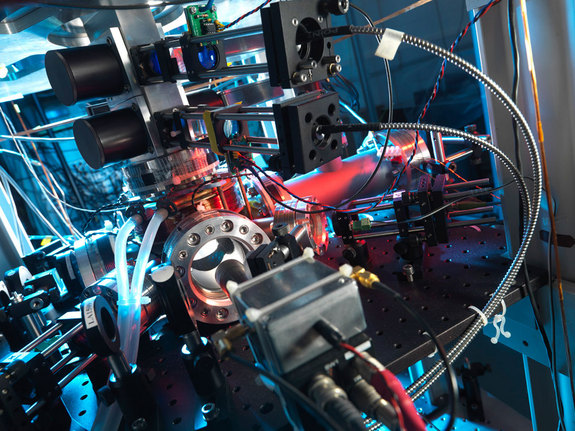
Atomic clocks precisely measure the ticks of atoms, the back and forth transition between two different atomic states. The atoms, commonly cesium, can transfer from the ground state to an excited state, but only if the frequency is just right. The trick to this process is finding just the right frequency to move directly between the two states and overcoming errors, such as Doppler shifts, that distort rhythm.

Today’s most accurate atomic clocks use laser-beam photons to “cool” atoms to low temperatures, to within a millionth of a degree of absolute zero. This reduces Doppler shifts and provides a long time to observe the atoms, which improves an atomic clock’s precision.

Laser technology has helped to better control the atoms, such as with optical lattices that can layer atoms into “pancakes” or egg-carton-like structures, immobilize them and helping eliminate Doppler shifts altogether. [Coming Soon: An Atomic Clock That Can Fit in Your Pocket ]

The official “rhythm” associated with the energy difference between the ground state and excited state of those cesium atoms, better known as the atomic transition frequency, yields something equivalent to the official definition of a second: 9,192,631,770 cycles of the radiation that gets a cesium atom to vibrate between those two energy states.

Future atomic clocks

Today’s atomic clocks mostly still use cesium, so according to NSF-funded physicist Kurt Gibble at Pennsylvania State University, the biggest advance in future atomic clocks will be a switch from measuring atoms vibrating at microwave frequencies to those vibrating at optical frequencies.

Today’s atomic clocks in GPS satellites, cell phone towers, the U.S. Naval Observatory’s master clock, and many other places in the world are microwave frequency clocks. These are the only clocks, at this point, that keep reliable time, Gibble said. Despite promising significantly more accuracy. “Just the higher frequency makes it a lot easier to be more accurate,” he added. “So far, optical standards don’t run for long enough to keep time, but they will soon.”

Gibble has an international reputation for assessing accuracy and improving microwave frequency clocks, including some of the most accurate clocks in the world: the cesium clocks at the United Kingdom’s National Physical Laboratory and the Observatory in Paris in France. He is now exploring new optical clocks that could further improve this field.

Optical frequency clocks actually operate on a significantly higher frequency than the microwave ones, which is why many researchers are exploring their potential with different atoms, including alkaline rare earth elements such as ytterbium, strontium and gadolinium.

Simien, whose research focuses on gadolinium, has studied minimizing or eliminating (if possible) key issues that limit accuracy. And recently, Gibble started work on another promising candidate, cadmium.

“Nowadays, the biggest obstacle, in my opinion, is the black body radiation shift,” Simien said. “The black body radiation shift is a systematic effect. We live in a thermal environment, meaning its temperature fluctuates. Even back in the day, a mechanical clock had pieces that would heat up and expand or cool down and contract. A clock’s accuracy varied with its environment. Today’s system is no longer mechanical and has better technology, but it is still susceptible to a thermal environment’s effects. Gadolinium is predicted to have a significantly reduced black body relationship compared to other elements implemented and being proposed as new frequency standards.”

According to Gibble, optical clocks are so accurate they would lose less than a second in the age of the universe, 13.8 billion years. And while Simien and Gibble agree that optical frequency atomic clock research represents the next generation of atomic clocks, taking accuracy to the next level, they recognize that most people don’t really care if the Big Bang happened 13 billion years ago or 13 billion years ago plus one second.

“It’s important to understand that one more digit of accuracy is not always just fine tuning something that is probably already good enough,” said John Gillaspy, an NSF program director who reviews funding for atomic clock research for the agency’s physics division. “Extremely high accuracy can sometimes mean a qualitative breakthrough which provides the first insight into an entirely new realm of understanding — a revolution in science.”

“Around the middle of the previous century, Willis Lamb measured a tiny frequency shift which led theorists to reformulate physics as we know it (not to mention earning him a Nobel Prize),” Gillaspy elaborated. “At a conference just this week, I heard a scientist discuss his idea to harness the GPS network’s precise timing to hunt for Dark Matter, one of the most outstanding problems in science today. Who knows when the next breakthrough will come, and whether it will be in the first digit or the 10th?

“Unfortunately, most people cannot appreciate why more accuracy matters, as evidenced in a recent blog post aimed at physicists in this field. The commenter wrote: ‘You’ve managed to find the single most depressing scientific endeavor of all time: Spend years of research trying to make an ultra-precise clock more precise. If they succeed, only electrons will notice’….These scientists know that they are, in fact, doing the sort of work that can change the world.”

“Interstellar” and beyond

Atomic clock researchers point to GPS as the most visible application of the basic science they study, but it’s only one way this foundational work holds promise.

Many physicists expect it to provide insight that not only illuminates understanding of fundamental physics and general relativity, but also advances quantum computing, sensor development and other sensitive instrumentation that requires clever design to resist the natural force of gravity, magnetic and electrical fields, temperature and motion.

Financial analysts, too, share concerns about the millions that could be lost in worldwide markets due to ill-synchronized clocks. In fact, on June 30, 2015, at 7:59:59 p.m. EDT, the world adds what is known as a “leap second” to keep solar time within 1 second of atomic time. However, because history has shown that most clocks won’t do it correctly, many major financial markets are planning to shut down for a period of time around this leap second, since it’s happening in the middle of a business day in many parts of the world — there’s concern that millions could be lost in worldwide markets due to ill-synchronized clocks.

“The reason you want better clocks isn’t to get accurate time over a long period down to the second. It’s the importance of being able to measure small time differences,” Gibble said. “The GPS looks at the difference in time for light propagating from several GPS satellites. The thing to remember is that the speed of light is one foot per nanosecond. If you want to know where you are, several GPS satellites send out a signal — a radio broadcast that tells where the satellites are and what time the radio signal left the satellite. Your GPS receiver gets the signals and looks at the time differences of the signals, when they arrive compared to when they said they left.”

Getting a GPS to guide us in deserts, tropical forests, oceans and other areas where roads aren’t around to help as markers along the way, one needs clocks with nanosecondprecision in GPS satellites to keep us from getting lost.

“If you want to know where you are to a couple of feet, you need to have timing to a nanosecond — a billionth of a second, which is 10 to the minus 9 of a second,” added Gibble. “If you want that clock to be good for more than a day, then already you have to be at 10 to the minus 14. If you want the system to go for two weeks or longer, then you need something significantly better than that.”

And then there’s the future to think about.

“Remember the movie, ‘Interstellar’?” Simien asks. “There is someone on a spaceship far away, Matthew McConaughey is on a planet in a strong gravitational field. He experiences reality in terms of hours, but the other individual back on the spacecraft experiences years. That’s general relativity. Atomic clocks can test this kind of fundamental theory and its various applications that make for fascinating science, and as you can see, also expand our lives.”

References:http://www.livescience.com/