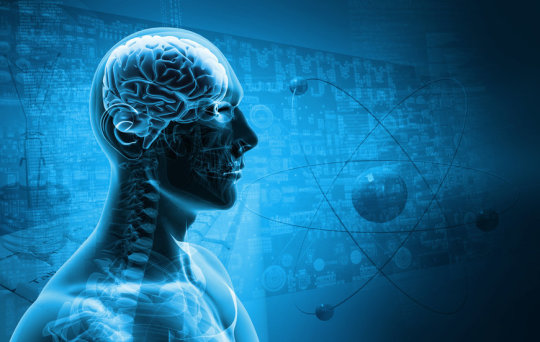
Team presents induction-powered biosensor chips detecting many molecules in vivo
achipplacedu

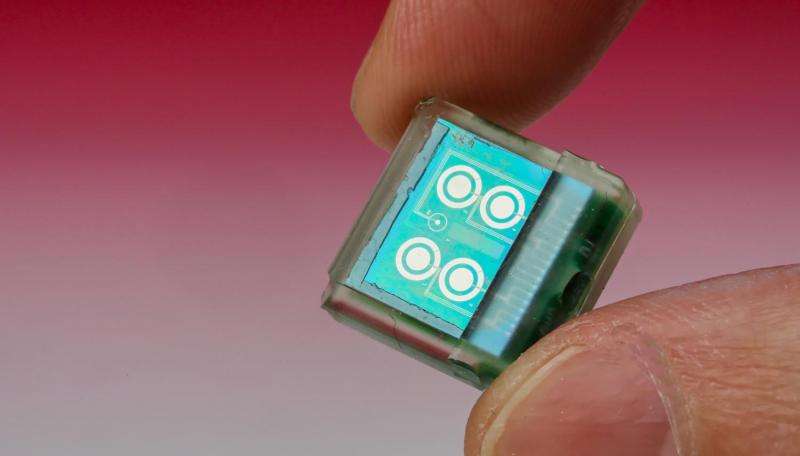
It’s only a centimeter long, it’s placed under your skin, it’s powered by a patch on the surface of your skin and it communicates with your mobile phone. The new biosensor chip developed at EPFL is capable of simultaneously monitoring the concentration of a number of molecules, such as glucose and cholesterol, and certain drugs.

The future of medicine lies in ever greater precision, not only when it comes to diagnosis but also drug dosage. The blood work that medical staff rely on is generally a snapshot indicative of the moment the blood is drawn before it undergoes hours – or even days – of analysis.
Several EPFL laboratories are working on devices allowing constant analysis over as long a period as possible. The latest development is the biosensor chip, created by researchers in the Integrated Systems Laboratory working together with the Radio Frequency Integrated Circuit Group. Sandro Carrara is unveiling it today at the International Symposium on Circuits and Systems (ISCAS) in Lisbon.

Autonomous operation

“This is the world’s first chip capable of measuring not just pH and temperature, but also metabolism-related molecules like glucose, lactate and cholesterol, as well as drugs,” said Dr Carrara. A group of electrochemical sensors works with or without enzymes, which means the device can react to a wide range of compounds, and it can do so for several days or even weeks.
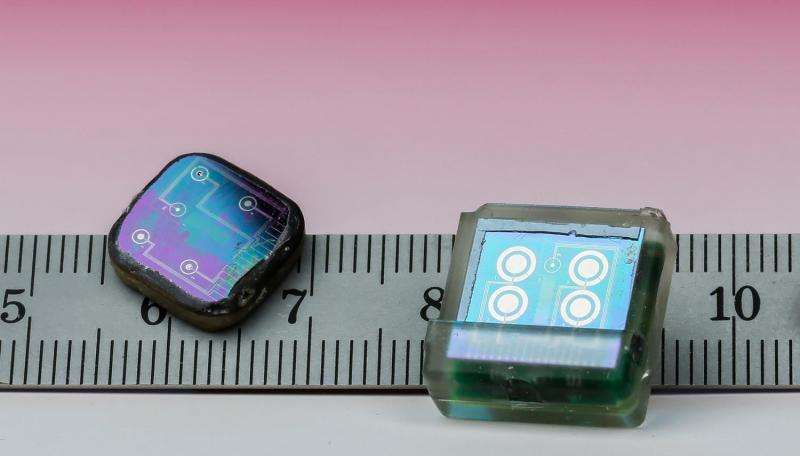
This one-centimetre square device contains three main components: a circuit with six sensors, a control unit that analyses incoming signals, and a radio transmission module. It also has an induction coil that draws power from an external battery attached to the skin by a patch. “A simple plaster holds together the battery, the coil and a Bluetooth module used to send the results immediately to a mobile phone,” said Dr Carrara.
1-achipplacedu

Contactless, in vivo monitoring

The chip was successfully tested in vivo on mice at the Institute for Research in Biomedicine (IRB) in Bellinzona, where researchers were able to constantly monitor glucose and paracetamol levels without a wire tracker getting in the way of the animals’ daily activities. The results were extremely promising, which means that clinical tests on humans could take place in three to five years – especially since the procedure is only minimally invasive, with the chip being implanted just under the epidermis.
“Knowing the precise and real-time effect of drugs on the metabolism is one of the keys to the type of personalised, precision medicine that we are striving for,” said Dr Carrara.

References: http://phys.org
Researchers develop two-legged robot that walks like an animated character

70-researchersd

When Walt Disney created Mickey Mouse, he didn’t give much thought to how he might bring his character to life in the real world. But robotics now puts that possibility within reach, so Disney researchers have found a way for a robot to mimic an animated character’s walk.

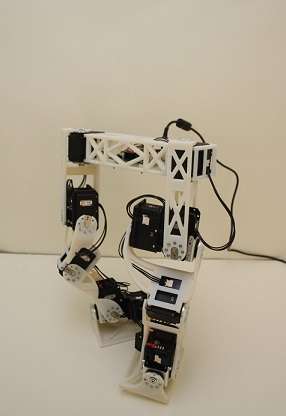
Beginning with an animation of a diminutive, peanut-shaped character that walks with a rolling, somewhat bow-legged gait, Katsu Yamane and his team at Disney Research Pittsburgh analyzed the character’s motion to design a robotic frame that could duplicate the walking motion using 3D-printed links and servo motors, while also fitting inside the character’s skin. They then created control software that could keep the robot balanced while duplicating the character’s gait as closely as possible.
“The biggest challenge is that designers don’t necessarily consider physics when they create an animated character,” said Yamane, senior research scientist. Roboticists, however, wrestle with physical constraints throughout the process of creating a real-life version of the character.
“It’s important that, despite physical limitations, we do not sacrifice style or the quality of motion,” Yamane said. The robots will need to not only look like the characters, but move in the way people are accustomed to seeing those characters move.
Yamane and Joohyung Kim of Disney Research Pittsburgh and Seungmoon Song, a Ph.D. student at Carnegie Mellon University’s Robotics Institute, focused first on developing the lower half of such a robot.
“Walking is where physics matter the most,” Yamane explained. “If we can find a way to make the lower half work, we can use the exact same procedure for the upper body.”
They will describe the techniques and technologies they used to create the bipedal robot at the IEEE International Conference on Robotics and Automation, ICRA 2015, May 26-30 in Seattle.
Compromises were inevitable. For instance, an analysis of the animated character showed that its ankle and foot had three joints, each of which had three degrees of freedom. Integrating nine actuators in a foot isn’t practical. And the researchers realized that the walking motion in the animation wasn’t physically realizable – if the walking motion in the animation was used on a real robot, the robot would fall down.
By studying the dynamics of the walking motion in simulation, the researchers realized they could mimic the motion by building a leg with a hip joint that has three degrees of freedom, a knee joint with a single degree of freedom and an ankle with two degrees of freedom.
Because the joints of the robot differ from what the analysis showed that the animated character had, the researchers couldn’t duplicate the character’s joint movements, but identified the position trajectories of the character’s pelvis, hips, knees, ankle and toes that the robot would need to duplicate. To keep the robot from falling, the researchers altered the motion, such as by keeping the character’s stance foot flat on the ground.
They then optimized the trajectories to minimize any deviation from the target motions, while ensuring that the robot was stable.

References: http://phys.org

Nano memory cell can mimic the brain’s long-term memory

150512075107_1_540x360

RMIT University researchers have mimicked the way the human brain processes information with the development of an electronic long-term memory cell.

Researchers at the MicroNano Research Facility (MNRF) have built the one of the world’s first electronic multi-state memory cell which mirrors the brain’s ability to simultaneously process and store multiple strands of information.

The development brings them closer to imitating key electronic aspects of the human brain — a vital step towards creating a bionic brain — which could help unlock successful treatments for common neurological conditions such as Alzheimer’s and Parkinson’s diseases.

The discovery was recently published in the materials science journalAdvanced Functional Materials.

Project leader Dr Sharath Sriram, co-leader of the RMIT Functional Materials and Microsystems Research Group, said the ground-breaking development imitates the way the brain uses long-term memory.

“This is the closest we have come to creating a brain-like system with memory that learns and stores analog information and is quick at retrieving this stored information,” Dr Sharath said.

“The human brain is an extremely complex analog computer… its evolution is based on its previous experiences, and up until now this functionality has not been able to be adequately reproduced with digital technology.”

The ability to create highly dense and ultra-fast analog memory cells paves the way for imitating highly sophisticated biological neural networks, he said.

The research builds on RMIT’s previous discovery where ultra-fast nano-scale memories were developed using a functional oxide material in the form of an ultra-thin film — 10,000 times thinner than a human hair.

Dr Hussein Nili, lead author of the study, said: “This new discovery is significant as it allows the multi-state cell to store and process information in the very same way that the brain does.

“Think of an old camera which could only take pictures in black and white. The same analogy applies here, rather than just black and white memories we now have memories in full color with shade, light and texture, it is a major step.”

While these new devices are able to store much more information than conventional digital memories (which store just 0s and 1s), it is their brain-like ability to remember and retain previous information that is exciting.

“We have now introduced controlled faults or defects in the oxide material along with the addition of metallic atoms, which unleashes the full potential of the ‘memristive’ effect — where the memory element’s behaviour is dependent on its past experiences,” Dr Nili said.

Nano-scale memories are precursors to the storage components of the complex artificial intelligence network needed to develop a bionic brain.

Dr Nili said the research had myriad practical applications including the potential for scientists to replicate the human brain outside of the body — which would remove the ethical barriers involved in experimenting on humans.

“If you could replicate a brain outside the body, it would minimise ethical issues involved in treating and experimenting on the brain which can lead to better understanding of neurological conditions,” Dr Nili said.

The research, supported by the Australian Research Council, was conducted in collaboration with the University of California Santa Barbara.

 References:http://www.sciencedaily.com/

Mobile battery life can be prolonged with system settings

By using crowdsourced measurements researchers explain the energy impact of smartphone system settings, and their results show how to improve a mobile device’s battery lifetime by adjusting the settings.

The NODES research group from University of Helsinki, Finland, has studied how the impact of different settings on battery lifetime can be estimated using crowdsourced measurements from a large community of devices. The research article “Energy Modeling of System Settings: A Crowdsourced Approach” was published in the 13th IEEE International Conference on Pervasive Computing (PerCom) in St Louis, USA, on 24 March 2015.

Mobile devices have a large number of different adjustable system settings whose energy impact can be difficult to understand for the average user, and even for the expert.

Some system settings have a direct and significant correlation with energy consumption, for example screen brightness and network connectivity. The energy impact of system settings and their combinations, such as the combination of roaming, high operating temperature, and bad signal strength, are much more difficult to predict. The research article by the Finnish computer scientists demonstrates that the energy impact of these non­trivial system setting combinations can be significant, and presents a new learning based method for assessing this impact.

The effects of different settings need to be modelled as a whole

The research is based on a large dataset that consists of device usage data gathered from over 150,000 smartphones and tablets. The dataset covers real life daily usage patterns and together with laboratory based specific high precision measurements serves as the empirical basis for the research work.

The energy model for system settings proposed in the research study makes it possible to give personalized, practical energy recommendations to the smartphone user. The research findings include the following:

  • Wi­Fi signal strength dropping one bar can cause over 13% battery life loss
  • High temperature can cause even 50% battery life loss, and high temperature is not always related to high CPU load
  • Automatic screen brightness is in most cases better than the manual setting

In addition to CPU, battery temperature and distance traveled together offer a good predictor of battery lifetime.

References: http://www.sciencedaily.com/